


- TRENDING
-
 Swiss Ball Hamstring Curls — The Best Exercise You've Never Done To Build A Toned, Perky Butt [UberExercise][W]ant a tight, toned, extra perky badonkadonk? Grab a ball and start rolling. One of THE most potent butt exercises in the workout world—sitting just behind squats and lunges—is likely...
 -
 The Workout Music Friday Five-Pack, V32 — Kaskade, Hermitude, Drake, & Sia[G]et amped. Every Friday we're dropping a five-pack of heart-thumping, blood-pumping workout songs to build out your playlist, hardwire a little energy into your workouts, and kickstart the...
 -
 The 30 Most Powerful Arm Exercises For Titanic, Toned Arms[I] can't shake the image of a Barbie & Ken factory. Whether you prefer titanic, sleeve-bursting arms or toned, defined, lean cannons, the following 30 exercises are powerful tools to help...
 -
 The Workout Music Friday Five-Pack, V31 — Action Bronson, Drake, Audien, & T.I[G]et amped. Every Friday we're dropping a five-pack of heart-thumping, blood-pumping workout songs to build out your playlist, hardwire a little energy into your workouts, and kickstart the...
 -
 [WOTM, 09/2015] Lean Out And Harden Your Body With The 3-Day Body Shredder Workout Split[T]hump, thump, thump. That's the sound of our latest fat-destroying, body-shredding behemoth. It's coming for you. We really hope you're ready. Whether you're brand new to the workout...
 -
 Your Go-To Workout-Approved Makeup Routine[W]hen I workout, 99% of the time it’s with a fresh, makeup-free face. Unfortunately I’m no Beyoncé and hardly ever wakeup with skin that's deemed “flawless." A majority of the time I’m...
 -
 Perk Up Your Derriere With The Build-A-Butt Workshop Glute Workout Plan [Workout Plans]Image: Oxygen Mag [W]elcome to the Build-A-Butt Workshop. It's a magical wonder emporium where saggy, flat butts are reconstucted and converted into plump, perky, well-shaped rumps. It's a...
 -
 The 40 Best Body Weight Exercises To Build Muscle & Blast Fat ANYWHERE [Exercise Lists][N]ow we're talking body. The world is your body-blasting battleground. Whether you're rendezvousing to a tropical island for a sultry, sun-soaked vacation, looking to squeeze in a quickie...
 -
 The Elite Six — 6 Advanced Six-Pack Ab Exercises To Build An HD, Razor Sharp Core[U]p your ab game. We're gunning for cover model status. Elite, exceptional six-pack abs require a MASSIVE amount of work and dedication. It's a hardcore commitment. But if your diet is on...
 -
 [Workout Plans] Limber Up For Battle With Our 5 Minute Foam Rolling Repertoire*The 5 Minute Foam Rolling Repertoire is part 2 in our series on foam rolling. Before jumping in, read through part 1, which provides a FULL-blown primer on all-things foam rolling. [I]t's...
 -
 How To Foam Roll Your Way To Reduced Pain, Regenerated Muscles, And Improved Mobility [Infographic][W]elcome to a brave new world. Whether you're a world-class athlete, running aficionado, or lifting legionnaire, foam rolling is an absolute must-do for anyone that exercises regularly. If...
 -
 5 Omega-3 & Mineral Rich Seafoods To Stuff Into Your Fitness DietImage: Shutterstock [F]or most of us who are starting a fitness routine, we know which exercises to start with but diet can be a little bit more confusing. We tend to forget to eat right even...
-




Fitbit Drops 3 New Bands, Including The Surge ‘Fitness Super Watch’ — Complete With GPS And Heart Rate Monitor [Product]
Well now we’re getting somewhere.
For the longest time I’ve been anti-fitness band, mainly because they’re all seemingly overpriced, glorified pedometers. Apps like Argus track steps, distance, calories burned, GPS routes, and even sleep—completely gratis—which makes dropping $100+ on a wristband feel utterly pointless.
Especially when you don’t need to strap on an additional piece of hardware, besides you know, your iPhone; which is already perpetually glued to your being.
If that wasn’t enough, look at sophisticated, game-changing fitness trackers like PUSH and Atlas. They’re pushing the limits of fitness tracking by automatically recognizing and gauging advanced weight-lifting metrics, including things like force, power, velocity, and explosive strength. And then there’s Athos, who is literally reinventing the definition of “fitness wearable,” by developing EMG-based intelligent clothing.
We’re there. The landscape of fitness wearables is evolving in a MASSIVE way. Finally. And big players are starting to take a hint.
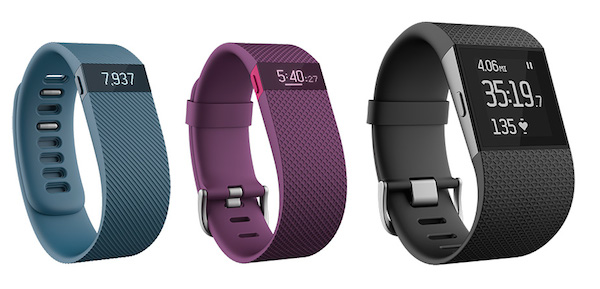
The latest? Fitbit. They’re finally beefing up their arsenal with the launch of 3 new fitness bands — the Charge, Charge HR, and Surge.
The Fitbit Charge, Charge HR, and Surge
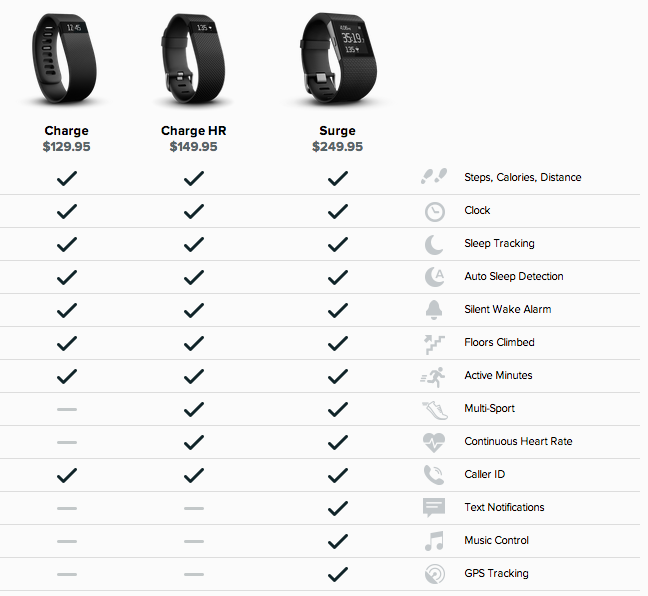
Image: Fitbit
Fitbit’s least sophisticated (and exciting) entrant is the Charge. It’s effectively a revamped Fitbit Force, which was recalled and discontinued earlier this year due to a massive skin-irritation issue. It’s a sleek band that measures all of the basics you’d come to expect from a competent fitness tracker — steps, calories burned, distance, floors, and active time, with an added caller ID readout.
The biggest upgrade from the Force? Automatic sleep detection. In the past you’d have to manually activate sleep tracking, which became a pain in the ass, especially if you passed out unexpectedly. That’s over. Now it detects sleep and tracks it automatically. It just knows.
As a base model, the Charge is nothing revolutionary. Things start to get interesting, and actually useful, with the addition of a heart rate monitor. And not one that requires a painfully annoying chest strap. The Charge HR continuously tracks heart rate right on the wrist, through a set of LED lights that detect changes in blood volume.
That’s completely game-changing and has massive power, both as an exercise and lifestyle device. During a workout, you’ll get a more accurate reading of calories burned and a direct proxy for exercise intensity. Intensity is everything. It’s an easy way to find your zone and determine which exercises, movements, and training techniques really get your heart screaming (cough, HIIT). You’ll know when you’re slacking and when you need to push harder.
And because the HR monitor works 24/7—it runs on a 5 day battery life—you’ll gradually get a vivid look at your resting heart rate (RHR), random fluctuations, and trends over time. Together, that can help identify times when you’re stressed or in a gloriously blissful state of peace, and paint a picture of overall heart health.
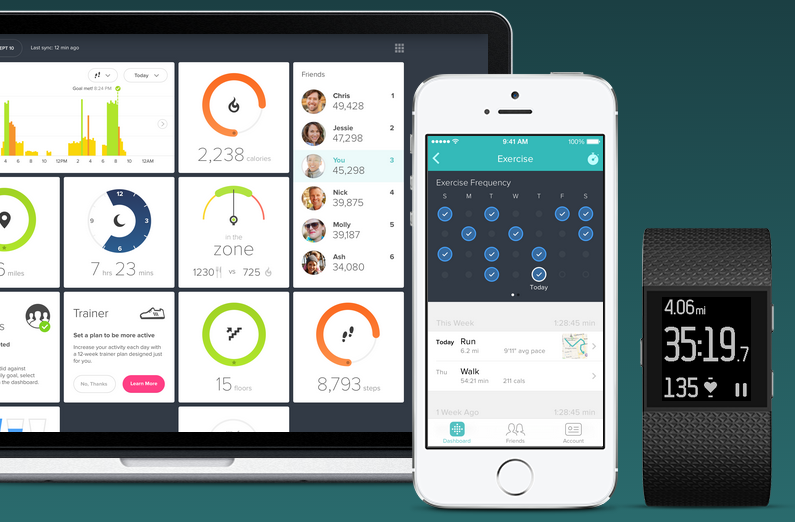
Finally, there’s their “Fitness Super Watch,” the Surge. It’s loaded with a bigger LCD touchscreen and 8 sensors (3-axis accelerometers, a gyroscope, compass, ambient light sensor, GPS and heart rate), the only major addition being the baked-in GPS. It’ll automatically map routes, track distance and elevation, and spit out split times. That’s cool as a do-everything device, but apps like MyFitnessPal and Runkeeper already provide the exact same outputs.
The Surge also offers smartphone music control via Bluetooth, but keep in mind, it’s limited to a 20 foot range (there’s no music storage).1
Fitbit Charge, Charge HR, and Surge — The Takeaway
The Charge is currently available for $129.95, while the Charge HR and Surge will be available in early 2015 for $149.95 and $249.95, respectively.
Your move: Wait for the Charge HR. Heart rate is the biggest sell here and really the only function you can’t get from a free app. The Surge doesn’t offer enough added value to justify dropping an extra $100.
.jpg)
Bryan DiSanto
He also contributes to Men's Health Magazine.
When he’s not working on his (or somebody else’s) abs, whipping up Eggocados, or running a Tough Mudder, he’s probably off yelling at a Carolina Panthers game somewhere.


 Lean It UP is a web community that touches all ends of the fitness spectrum. We regularly publish workout plans, nutritional analysis, product reviews, supplement advice, recipes, and other related content that can help inform and educate on the most effective, practical ways to improve fitness levels, aesthetics, and overall health. We want to help YOU build your own perfect body -- hop on for the ride.


